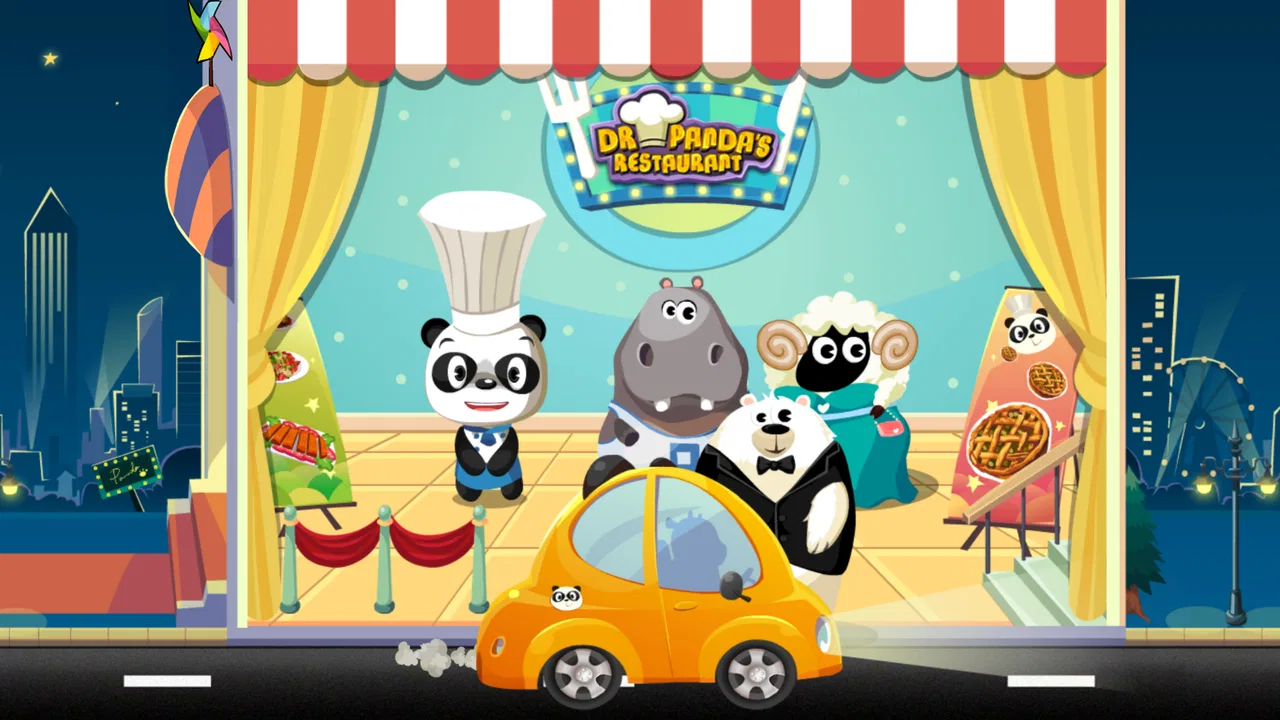
Dr. Panda Restaurant
- 3.9
- Rating
- 100.00K
- Installs
- $3.99
- Price

 Analysis by App-foxy
Cooking games often try to turn a simple recipe into a race, a puzzle, or a stream of upgrades. Dr. Panda Restaurant takes a gentler route. I spent time with it as a small, child-friendly kitchen where animal guests arrive, ingredients are prepared, and the fun comes from trying things rather than beating a timer. That makes it a particularly approachable educational game for younger players who enjoy pretend play and hands-on discovery.
The basic idea is easy to understand: you cook food for animal customers and watch their reactions. There is no complicated rulebook to study before starting, and the bright presentation makes the restaurant feel inviting almost immediately. I found that simplicity useful for children who may become frustrated by games that demand reading, fast reflexes, or precise planning from the first minute.
At the same time, this is not a full restaurant-management simulation. You should approach it as a relaxed cooking activity rather than a game about running a business, collecting money, or optimizing a menu. That distinction matters when deciding whether it suits your family. I would recommend it to parents looking for calm screen time with a food theme, but I would not choose it for a child expecting deep progression or a competitive challenge.
You May Also Like

 Blood Strike: 2.5 Anniversary
Blood Strike’s Loadouts Turn Every Drop Into a Tactical Gamble
A close look at Blood Strike’s custom loadouts: how fast access to signature weapons reshapes its battle royale rhythm, rewards preparation, and narrows the gap between fights.

 Pandora - Music & Podcasts
Pandora’s Music Is Easy to Start, but Harder to Recover
Pandora’s strength is its low-effort path from a seed to a station. Its weak spot is how much confidence it asks you to place in connection, setup, and quiet recovery.

 8 Ball Pool
 Is Built on Rivalries, Rematches, and Routine
A close look at the rivalries, rematches, shared routines, and unanswered safety questions that turn a quick pool match into a persistent mobile community.

 Samsung Music
’s Quiet Strength Is Playing What You Already Own
Its reach comes less from spectacle than from dependable access to a personal library. That simplicity is both the app’s strongest retention engine and its ceiling.

 AccuWeather: Weather Radar
AccuWeather Review: A Quick, Clear Forecast for Everyday Decisions
For everyday plans, the best forecast is the one you can understand quickly. AccuWeather makes rain timing, radar, and local conditions easy to act on, with a few trade-offs.

 Hill Climb Racing
Why Hill Climb Racing Still Turns Crashes Into One More Run
A tiny car, a bumpy hill and one more upgrade: Hill Climb Racing keeps resurfacing because its simple chaos makes every near-miss feel personal.
More From Our News Desk
View All News


How the restaurant feels in everyday play
I find the everyday rhythm easiest to enjoy when I treat each visit as a small make-believe meal, rather than trying to stretch it into a long session. That leaves room for a child to choose the pace and explain their decisions, which can make repeated kitchen actions feel more purposeful. The next thing I’d consider is how to set up the device and play space so those short visits stay comfortable.
A welcoming kitchen built around experimentation
The strongest part of the experience is the sense that the kitchen is there to be explored. Instead of making every action feel like a test, the game encourages children to handle ingredients and see what happens. That approach gives the restaurant a playful, almost toy-like quality. A child can focus on the sequence of preparing a meal, but can also enjoy the reactions and small surprises that make the activity feel personal.
I especially like this design for short sessions. A child can open the game while waiting for dinner, play through a few cooking interactions, and stop without feeling that an important mission has been abandoned. There is no need to remember a complicated strategy between sessions. The restaurant is easy to return to because its central activity remains clear: prepare something and serve it to an animal guest.
That simplicity also gives parents a practical advantage. If you are introducing a young child to a tablet or phone, the game offers a more focused activity than an open video feed. It does not require the child to understand a large fictional world before having fun. The kitchen itself is the lesson space, and the actions are concrete enough for a child to explain what they are doing while playing.
Why the educational label makes sense
This is an educational game in a broad, activity-based sense rather than a formal teaching tool. It can support recognition of ingredients, ordering actions, hand-eye coordination, and simple cause-and-effect thinking. A child may begin to notice that preparing food involves several steps, or that different choices produce different reactions from the guests.
I would not use it as a replacement for a structured cooking lesson. It does not turn a child into a real cook, and playing it will not teach safe knife handling, measurements, heat management, or kitchen hygiene. Its value is more basic and more playful: it lets children rehearse the idea of preparing and sharing food without the risks of a real kitchen.
One useful way to play is to sit beside a child and ask them to describe each action before they take it. “What should we do first?” or “How do you think the guest will react?” turns a few taps into a conversation about sequence and prediction. That is where I think the game offers more than passive entertainment. The app supplies the play setting, while the adult can add language, counting, and reasoning around it.
A realistic use case for families
Imagine a child using a tablet at the kitchen table while a parent prepares an actual meal. The child can play restaurant, talk about the ingredients on screen, and compare the pretend meal with what is being cooked nearby. That makes the game a natural conversation starter rather than an isolated distraction.
It can also work well for a younger child who wants to imitate an older sibling or adult. Real cooking may be unsuitable because of hot surfaces and sharp tools, but a virtual kitchen gives the child a safe way to participate in the idea of preparing food. I would still supervise the session, not because the game is difficult, but because shared play helps prevent the activity from becoming repetitive tapping with little thought behind it.
What the current version tells me
The current version is 26.3.41, and the game remains positioned as a compact restaurant experience rather than a large, constantly expanding platform. The developer is Dr. Panda, a name closely associated with playful experiences aimed at children. The game has been available since August 30, 2012, so its appeal is not based on being a brand-new release. Its continued presence suggests that the core restaurant concept still has a place among simple children’s games.
For existing players, that long history can be reassuring in one sense: the concept has had time to settle into a recognizable form. New users should nevertheless judge it by what it is today, not by the expectation that an older game will offer the same scale or visual complexity as newer tablet titles. I see it as an established, focused activity, and that focus is both its charm and its main limitation.
How the game compares with common alternatives
Compared with fast-paced restaurant games, this one feels much less demanding. Many alternatives emphasize serving as many customers as possible, upgrading equipment, or managing a growing business. Those games can be exciting for older children, but they also introduce pressure and more complicated goals. Dr. Panda Restaurant is better when the child’s priority is exploration and pretend play.
Compared with recipe or food-learning apps, it is more playful and less instructional. A dedicated cooking lesson may do a better job explaining ingredients, nutrition, or real-world techniques. Here, the educational value comes from interaction and imagination. I would choose this game for a child who learns through acting things out, not for someone specifically asking how to follow a real recipe.
Compared with open-ended digital dollhouses, the restaurant gives play a clearer theme. The child is not simply moving characters around a room; there is a reason for the kitchen, the food, and the guests. That structure can help a child who needs a little direction. On the other hand, a broader pretend-play app may offer more settings and longer-term variety.
Small discoveries that improve the experience
My first practical tip is to let the child repeat an action without immediately correcting them. The value is often in seeing what happens after an unusual choice. If an adult rushes to demonstrate the “right” procedure, the game can become a copying exercise. Giving the child a moment to test an idea makes the kitchen feel more like a place for discovery.
A second useful approach is to use the game for sequencing practice. Ask the child to narrate the meal from beginning to end, then invite them to notice which step changed the guest’s response. This adds a layer of memory and reasoning that is easy to miss when the game is played silently.
A third insight is that the restaurant works better as a shared activity than as a long unsupervised session. The interactions are friendly, but the range of actions is intentionally simple. An adult can extend the life of the game by inventing a customer story, discussing tastes, or connecting the pretend meal to a real family meal. Without that extra imagination, some children may reach the limits of the experience fairly quickly.
There is also a useful trade-off in the game’s low-pressure design. Because it does not push the player with demanding goals, it is comfortable for beginners and children who dislike failure. The same lack of pressure may disappoint a child who wants constant rewards, difficult levels, or a strong sense of advancement. Knowing the child’s preferred play style is more important here than choosing by the restaurant theme alone.
Who will enjoy it most
I think it is best suited to younger children who like animals, food, and imaginative role-play. It is also a reasonable choice for parents seeking an age-appropriate cooking game that can be understood without a long explanation. The content rating is Everyone, which fits the gentle tone and broad family audience.
It may be especially helpful for a child who is hesitant about trying a new food-related activity. A virtual restaurant can open a conversation about ingredients and meals without placing a real plate in front of them. That does not guarantee a change in eating habits, but it can make food a less intimidating subject to discuss.
I would be more cautious about recommending it to older children who already enjoy management games. They may find the restaurant too limited if they are looking for staff, finances, menus, upgrades, or a campaign with increasingly difficult objectives. In that situation, a more systems-heavy cooking game would probably provide better value.
Cost, access, and device expectations
The game costs $3.99, so it sits in the paid-app category rather than relying on a free download model. I see that as a positive for families who prefer to make one clear purchase instead of navigating a game built around repeated spending. The important question is not whether it is inexpensive in isolation, but whether the child will return to this particular style of play often enough to justify it.
It has passed 100K installs and holds a 3.9 average from around 1.8K ratings, with 168 reviews shown alongside that feedback. Those figures suggest a real audience, while also indicating that it is not universally loved. I would read the rating as a reminder to keep expectations realistic: the game has a clear appeal, but its simple format will not suit every player.
The minimum operating-system requirement is Android 6.0. That makes it accessible on a range of older Android devices, although smooth performance can still depend on the individual phone or tablet. Before buying, I would check that the device has enough room and that the screen is comfortable for a child to use. A larger tablet generally makes food interactions easier for small fingers than a compact phone.
Where the experience still falls short
The main weakness is limited depth. The restaurant theme is attractive, but the game does not appear designed to keep expanding into a complex management challenge. Once a child understands the basic rhythm of preparing and serving food, the novelty may depend heavily on imagination and repetition.
That is not a flaw for the intended kind of relaxed play, but it becomes a real drawback if you are paying for a game expected to occupy a child for long periods. I would not present it as a complete entertainment library. It is more like a digital activity box: useful, pleasant, and easy to pick up, but not endlessly broad.
The educational benefit also depends on how the child engages with it. A child who simply taps through every interaction may gain less than a child who talks about the ingredients, predicts reactions, and invents stories for the guests. Parents looking for measurable lessons or clear learning reports may prefer a more explicitly academic app.
Another limitation is that the game’s calm pace may feel too quiet for children accustomed to constant stimulation. There is no need to treat that as a problem by itself; a slower game can be refreshing. Still, if a child loses interest whenever there is no score chase or urgent objective, the restaurant may not hold attention for very long.
What existing users and new buyers should watch
For existing users, the current version number is worth noting mainly as a sign that the app remains maintained in a recognizable modern form. I would watch future updates for practical improvements that affect everyday play, such as compatibility, responsiveness, and ease of use on newer devices. Those details matter more here than ambitious new systems, because the appeal depends on the kitchen staying simple and dependable.
For new buyers, I would pay attention to whether the child enjoys open-ended repetition. If they like making the same activity their own, the restaurant can remain engaging through stories and experimentation. If they need a clear sequence of levels, unlockable goals, or increasing difficulty, it is better to choose a different kind of cooking game from the start.
I would also keep the price in perspective. A paid game can be a good fit when it replaces a stream of distracting free apps, but it still needs to match the child’s interests. Watching a short play session before purchasing, where possible, is a sensible way to see whether the child responds to the slow, tactile style.
My final take after spending time in the kitchen
Dr. Panda Restaurant is a warm, approachable educational game that succeeds by keeping its idea small. It gives children a friendly place to prepare food for animal guests, try actions without much pressure, and build their own pretend-play stories. I appreciate that it does not confuse a child-friendly cooking activity with a demanding restaurant business simulator.
Its best use is as a short, shared experience: a few minutes of play followed by conversation about ingredients, order, taste, and hospitality. It is less convincing as a long-term challenge or a substitute for a real cooking lesson. Parents should buy it for the atmosphere and accessible interaction, not for deep progression.
At $3.99, I think it is worth considering for a younger child who already enjoys animal characters and kitchen play. I would skip it for an older player seeking strategy, competition, or extensive content. For the right audience, though, this is a gentle digital restaurant that can turn ordinary screen time into a little imaginative cooking session.
FAQs for Dr. Panda Restaurant
01What is Dr. Panda Restaurant?
Dr. Panda Restaurant is an interactive children’s cooking and role-playing game in which players run a restaurant, prepare meals, and serve animal customers. Children can choose ingredients, use kitchen tools, cook food in different ways, and observe playful reactions from guests. The open-ended design encourages experimentation rather than focusing on strict scores, timers, or complicated objectives.
02Is Dr. Panda Restaurant suitable for young children?
The game is designed primarily for young children, especially preschool and early elementary-age players. Its controls are simple, colorful, and easy to understand, with activities based on tapping, dragging, and selecting objects. Parents should still review the recommended age rating for their device, as children’s abilities vary and some may need help learning the available kitchen interactions.
03Does Dr. Panda Restaurant require an internet connection?
Most of the core gameplay in Dr. Panda Restaurant can generally be enjoyed offline after the application has been installed, which makes it convenient for travel or situations without Wi-Fi. However, an internet connection may be needed for downloading the app, receiving updates, restoring purchases, or accessing certain store-related functions. Availability can also vary by platform and version.
04Are there advertisements or in-app purchases in Dr. Panda Restaurant?
The business model may depend on the version, store listing, and region in which Dr. Panda Restaurant is downloaded. Some editions may be paid upfront, while others can include optional purchases or additional content. Parents should check the current Google Play or App Store description before downloading and review device purchase settings to prevent accidental transactions by children.
05What can children do in Dr. Panda Restaurant?
Children can explore a variety of restaurant activities, including selecting ingredients, preparing dishes, operating kitchen equipment, and serving meals to animal customers. They can experiment with different food combinations and watch characters respond in humorous ways. Because the game is open-ended, there may not be a traditional campaign or final level; its main appeal is creative, relaxed play.
Pros
- Simple controls make it easy for young children to play independently.
- Bright animations and friendly characters create a welcoming atmosphere.
- Open-ended cooking encourages creativity without time limits or failure states.
- Different ingredients and kitchen tools offer varied play experiences.
- Suitable for short play sessions and casual entertainment.
Cons
- Limited challenge may feel repetitive for older children.
- Some content may require an additional purchase or paid version.
- The game offers little educational guidance beyond basic role-play.
- Activities can become predictable after repeated visits to the same locations.
- Parental supervision may still be needed to manage in-app purchase access.

Dr. Panda Restaurant
Gallery